Gingerbread Embroidery Seamless Patterns
First Impressions: Sweet, Cohesive, and Surprisingly Versatile
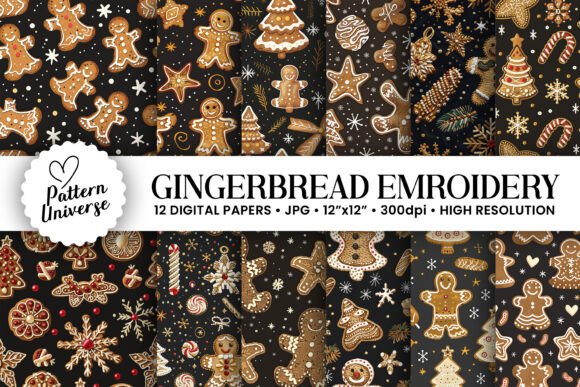
As someone who’s stitched hundreds of holiday designs—from delicate lace-inspired motifs to bold, modern lettering—I opened Gingerbread Embroidery Seamless Patterns expecting charm, but not quite this level of thoughtful cohesion. These aren’t just gingerbread men with candy buttons slapped onto a grid. They’re rhythmically paced, gently scaled, and built with visual breathing room—exactly what you need when planning repeat layouts for tote bags, tea towels, or nursery wall art. The AI generation is polished, not generic: clean outlines, balanced negative space, and subtle variations in pose and accessory (a candy cane here, a bow there) keep the repetition from feeling mechanical. It feels like a curated collection—not a bulk export.
A Real-World Test: Stitching a Holiday Tote for My Local Boutique
Last week, I used one of the Gingerbread Embroidery Seamless Patterns as the central repeat motif on a set of linen-cotton blend tote bags for a small-town gift shop. We planned three staggered rows across the front panel—no borders, no framing—just the pattern flowing naturally. What stood out immediately was how well the design handled scale shifts. At 3.5" wide per repeat, it read clearly from across the room; at 2" for inner pocket accents, the details (like piped icing lines and tiny gumdrop clusters) stayed legible without overcrowding. Customers didn’t just say “cute”—they paused, traced the stitching with their fingers, and asked, “Is that hand-drawn?” That’s the handmade product illusion working.
Where It Shines—and Where You’ll Want to Pause
Gingerbread Embroidery Seamless Patterns excels in medium-to-large surface embroidery projects:
- Custom apparel: Works beautifully on sweatshirt cuffs, back yokes, or sleeve bands—especially where gentle repetition adds rhythm without overwhelming texture.
- Baby embroidery: Soft curves and rounded edges translate well to onesies and burp cloths; minimal fine detail means fewer snag points for little hands.
- Holiday gifts & boutique branding: Ideal for matching pillow covers + tea towels + gift tags—all unified by the same seamless flow. Feels intentional, not pieced together.
- Digital embroidery file use: Perfect for printable mockups or digital product previews—clean vector-style edges hold up crisply in PNGs and PDFs.
But be mindful on:
- Stretchy or thin fabric: The moderate stitch density (likely medium fill + satin outlines) can pull lightweight knits. Always pair with cutaway stabilizer—and test first on scrap fabric.
- Curved surfaces (caps, tumblers): Seamless doesn’t mean distortion-proof. On a curved cap front, the pattern may compress slightly at the crown. Consider using only 1–2 repeats instead of full coverage.
- Dark or textured backgrounds: While the design reads well on cream or oatmeal linen, dense fill areas can blur on heavy tweed or black terry cloth. Try simplifying with running-stitch-only versions if your machine allows editing.
- Tiny hoop sizes (<2.5"): Some motifs include tight candy-cane swirls or clustered gumdrops that lose definition below 2". Stick to larger hoops or isolate single elements for small patches.
What It Does for Your Craft Business—Beyond Aesthetics
If you’re an Etsy seller or small shop owner, Gingerbread Embroidery Seamless Patterns quietly lifts your perceived value. Why? Because seamless patterns signal intentionality—they tell customers you didn’t grab a random clipart file. When someone sees consistent, flowing gingerbread motifs across your holiday collection (tote, apron, tea towel), they subconsciously register professionalism and brand care. That builds trust faster than any banner saying “handmade with love.”
It also streamlines production. No more manually aligning and duplicating motifs—you drop in the repeat, adjust spacing once, and go. For commercial embroidery work, that’s billable time saved. For hobbyists selling at craft fairs, it means cleaner, more cohesive booth displays. And for digital product sellers? These are strong design assets—ideal for bundling with coordinating fonts or color palettes.
Practical Designer Notes Before You Stitch
Before committing to a full run—or listing your finished product—here’s what I always do with new Gingerbread Embroidery Seamless Patterns:
- Run a test stitch on scrap fabric—same type, same stabilizer, same thread colors you plan to use.
- Check thread color contrast, especially for satin-stitched outlines. Light brown thread on tan fabric disappears; off-white on navy pops.
- Review stitch density visually—not just in software. Dense fills can stiffen lightweight fabrics. If needed, reduce fill density by 10–15%.
- Confirm hoop size compatibility. Seamless doesn’t mean “fits every hoop”—some repeats span 4x4", others push 5x7". Know your limits.
- Inspect small details at actual stitch-out size. Zoom in on your machine screen or print a 1:1 paper layout.
- Test in black-and-white mockups to assess contrast and clarity without color distraction.
- Compare performance on light vs. dark fabric backgrounds—some elements (like fine icing lines) vanish on busy prints.
- Verify licensing terms before selling finished items or reselling digital files. Since these are AI-generated Graphics, commercial use rights aren’t automatic—check the source.
Final Thought: A Thoughtful Tool, Not Just a Trendy File
Gingerbread Embroidery Seamless Patterns isn’t flashy—but it’s reliable, adaptable, and quietly sophisticated. It doesn’t shout “holiday!” It whispers “thoughtful gifting,” “cozy craftsmanship,” and “small business care.” Whether you’re stitching a personalized baby blanket, prepping holiday stock for your Etsy shop, or designing a limited-run embroidered apron line, this set delivers consistency without compromise. Just remember: even the sweetest pattern needs smart execution. Test it. Tune it. Trust your eye—and your needle.