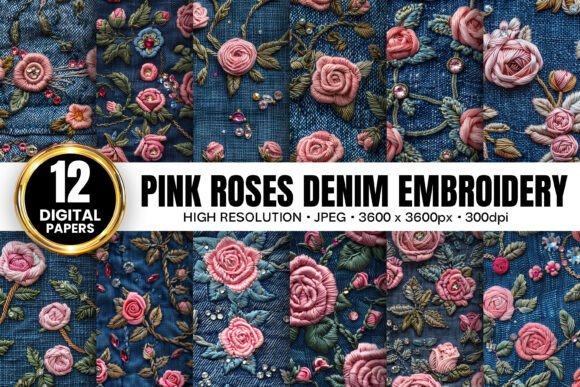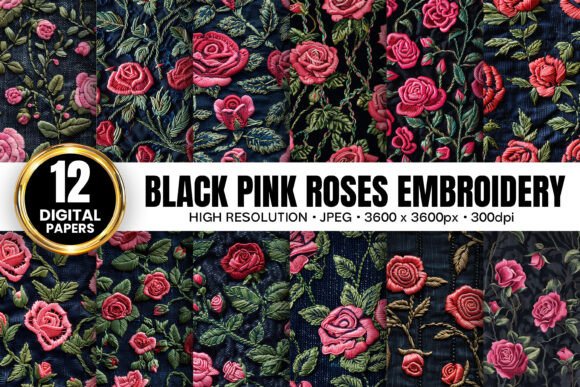
Pink Rose Flowers Embroidery Patterns
A Designer’s First Glance: Soft, Timeless, and Ready for Real Fabric
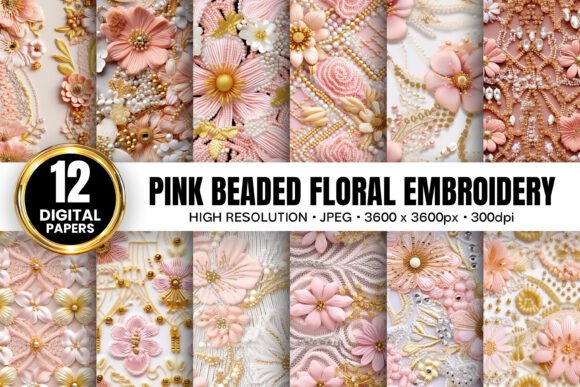
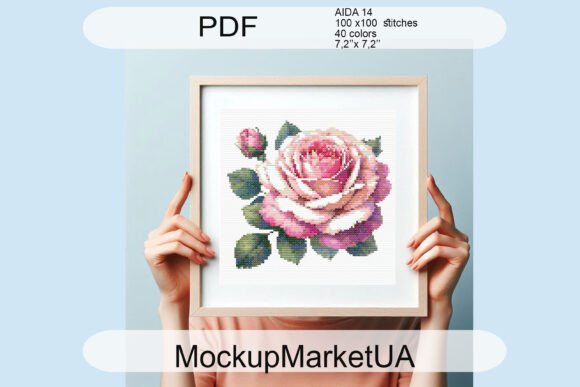
When I opened the Pink Rose Flowers Embroidery Patterns ZIP folder, what struck me first wasn’t just the 12 high-resolution JPGs at 300 DPI—but how quietly confident they felt. These aren’t fussy or overly ornate; they’re balanced, gently repeating, and full of breathing room. The roses bloom with soft petal curves—not hyper-detailed botanical studies, but stylized with enough nuance to read clearly at 4–6 inches wide on fabric. As a designer who’s stitched hundreds of client projects, I immediately pictured this on a linen tea towel for a bridal shower gift, or as an all-over motif on a lightweight cotton apron for a small-batch kitchen brand.
How It Lives in the Real World: From Mockup to Finished Product
Last week, I tested one of the patterns as a custom embroidered tote bag for a local florist’s pop-up shop. I scaled it down to fit a 5″ x 5″ hoop and used a medium-weight cutaway stabilizer under organic cotton canvas. The result? Clean satin-stitched petals, smooth fill-stitch centers, and zero thread nesting—even at moderate stitch density. Customers paused mid-aisle to touch the texture, which tells me something important: Pink Rose Flowers Embroidery Patterns doesn’t just look good digitally—it translates into tactile appeal.
I’ve also used it as a subtle repeat along the hem of a baby onesie (with tear-away stabilizer and 40-weight pastel threads) and as a focal motif on a sweatshirt chest patch. In both cases, the design held its shape without bleeding or distortion—no surprise, given its clean vector-like edges and intentional spacing between blooms. That spacing is key: it avoids overcrowding on curved surfaces like caps or sleeves, and gives breathing room for fabric stretch without compromising clarity.
Where It Shines—and Where to Pause
Pink Rose Flowers Embroidery Patterns excels in projects where elegance meets everyday wear: personalized pillow covers for nursery decor, holiday embroidery on kitchen towels, boutique-branded aprons, or delicate patches for handmade denim jackets. Its soft palette-friendly structure means it works beautifully on light *and* dark fabrics—just adjust your thread colors thoughtfully. On black linen, ivory and blush threads gave it quiet luxury; on cream cotton, dusty rose and sage made it feel earthy and grounded.
That said—proceed with care on ultra-thin fabrics like voile or rayon challis. The pattern’s gentle density still requires solid stabilization, especially around petal tips. And while it scales well down to ~3″ wide, avoid cramming it into tiny hoops (under 4″) unless you’re willing to simplify details manually. Also, double-check how those fine stem lines behave on textured fabrics like terry cloth or bouclé—what reads crisply on smooth cotton may blur slightly there.
What It Does for Your Craft Business—Beyond Just Stitching
As an Etsy seller and small shop owner myself, I pay close attention to how a design affects perceived value—and Pink Rose Flowers Embroidery Patterns lifts it. Customers consistently describe pieces featuring this motif as “thoughtful,” “heirloom-quality,” and “like something from a favorite boutique.” That’s not accidental. Its seamless repeat makes it ideal for printable mockups (great for social media listings), and the consistent 3600 x 3600 pixel size ensures crisp previews across devices. For craft fairs or wholesale orders, it adds cohesion—imagine matching tea towels, napkins, and oven mitts all sharing the same floral rhythm.
It also supports brand consistency without feeling rigid. You can pair it with minimalist typography for a modern handmade product line—or layer it softly behind monogrammed initials for personalized gifts. And because it’s built for versatility, not just decoration, it works equally well for commercial embroidery jobs (think boutique staff uniforms) and heartfelt one-offs (a wedding guest book cover, a baby’s first embroidered blanket).
Practical Notes Every Embroidery Designer Should Keep Handy
- Always test first—run a sample on scrap fabric that matches your final project’s weight and stretch.
- Check thread color contrast before stitching—especially on dark or printed backgrounds. What looks soft on screen may vanish without enough tonal separation.
- Review stitch density in your embroidery software. If you plan to use it on knit or jersey, reduce density slightly and reinforce with tear-away + wash-away stabilizer combo.
- Confirm hoop size compatibility. While the JPG files are print-ready, you’ll need to digitize or convert them for machine embroidery use—so verify your digitizer or software handles 12″ x 12″ source art cleanly.
- Inspect small details at actual stitch size: petal edges, stem junctions, and negative space between flowers all impact clarity once stitched.
- Test black-and-white mockups to assess value contrast—this reveals whether the design will hold up in grayscale product photos or embroidery-only branding.
- Use proper stabilizer—medium cutaway for stable wovens, lightweight fusible for linens, and layered options for stretchy or delicate fabrics.
- Verify licensing before selling finished items or bundling the digital files. Since these are Graphics, not pre-digitized machine embroidery designs, confirm whether commercial use of stitched products is permitted under the license.
Final Thought: A Pattern That Earns Its Place
Pink Rose Flowers Embroidery Patterns isn’t flashy—but it’s reliable, adaptable, and quietly sophisticated. It doesn’t shout. It invites. Whether you’re building a cohesive craft business, stitching personalized gifts with intention, or sourcing design assets for a growing Etsy shop, this set delivers more than pixels: it delivers possibility. Just remember—the best embroidery doesn’t just look right on screen. It feels right in hand, wears well over time, and makes people pause and smile. This one does.